

How To Play Lower Register C On Flute
These are some of the questions I get asked the nigh...
"How do I play high notes easily?"
"Why aren't my depression notes sounding properly?"
"Why do my notes keep cracking between octaves?"
If you're struggling with whatever one of these playing challenges, this article explains the common solution - developing a flexible embouchure.
Hither's what we're covering today...
Let's go started. (Feel free to skip to the annals that's challenging you lot most)
The Flute Range
The range of flute notes spans three octaves from centre C on the pianoforte (too called C4) to C7.

The three octave range of notes of a flute. Epitome Source: http://www.composeforums.com/alphabetize.php?topic=5.0
If you've got a longer B foot joint, yous'll be able to attain a low B (B3).
In the pic, you'll see the C human foot at the top (standard on student model flutes) and the B foot below (standard with intermediate level flutes).

=
The Registers
The flute notes are divided into iii groupings or 'registers' - cleverly named low, centre and high. Each register has its feature tone.
A combination of varying air speed and embouchure shape is the fundamental to moving between these octaves, and maintaining great sound.
The Depression Register (Start Octave)
The depression register is described every bit having a warm, soft and dark sound.
Here's the notes in the C major scale from C4 to C5.

How to play the first octave
Here's my like shooting fish in a barrel pointers to have those low notes sounding gorgeously lush...
The problem most people run into when playing low notes is using too much air.
Air that's moving too fast tin can hateful accidentally over blowing the notation and leaping up to its harmonic.
(Notes actually incorporate multiple sound moving ridge frequencies. When you over blow you're just borer into a frequency that's a office of the original note you're trying to play).
Here's an example of the harmonic series possible when over blowing a low D.

The harmonic series possible starting from a low D. Epitome source: www.flutetunes.com
And so its a balancing act.
You need to balance between playing with ENOUGH air to make the sound full (and non blusterous and weak) but as well inside the natural limit to the dynamic range so you don't over accident.
Experiment to observe what these dynamic limits are for you (so you learn not to play past it!).
The Centre Register (2nd Octave)
The center annals notes are brighter and more than vibrant sounding than the lower annals. And yous can play them with greater dynamic contrast.
Here's the C major scale from C5 to C6.

How to play the 2nd octave
OK, this isn't rinse and repeat from the first octave.
These middle annals notes need a different arroyo so you tin play with a dainty tone, first time EVERY time.
Hither's how...
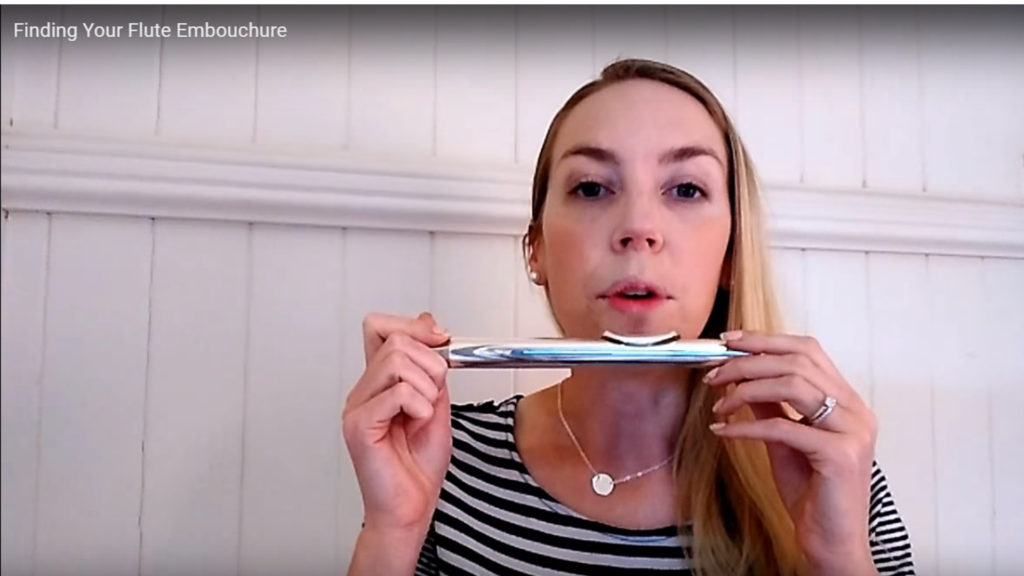
Beware this is simply a very subtle forward movement, the outer lips shouldn't exist puckered beyond and roofing the embouchure hole.
("The Kiss" is really ane of four FATAL embouchure mistakes that can wreak havoc on audio. I prove you what the other iii are in my Embouchure Bootcamp serial)
Once once more its possible to jump upwardly an octave or into your harmonics if you give it likewise much 'oomph.' You'll find that the annotation fingerings for some notes are the same as the depression annals so all the changes you need to brand must come from air and embouchure shape.
The High Register (3rd Octave)
The high annals is the nigh challenging and the last register we tackle as learners.
Here's the C chromatic scale from C6 to C7. (That's every notation including the sharps and flats).

Going cantankerous-eyed from all the lines above the staff is a definite chance.
Playing the third octave
Don't panic, I've got you.
Hither's the keys to making that final rise to the Everest of flute notes...
This move decreases the distance the air travels to the far wall of the embouchure hole and decreases the aperture's overall size.
Some players tin overcompensate a lack of jiff back up, book and air pressure level by squeezing the outer lips together to strength the air through a tiny discontinuity opening.
All this does is fatigue your lips and facial muscles, makes playing with any dynamics nearly impossible and your tone sound strangled and thin.

Which octave should you acquire start?
Trying to learn your flute notes is non like learning the alphabet. You don't offset from the lowest notation and work your style upwardly to the highest.
Beginners should start learning their kickoff notes in the depression register.
B-A-G are usually your first notes.
Then you slowly expand up and down the note scale until you reach the middle annals.
The low and centre registers are the easiest to go a quality sound, faster.
And fingerings are simpler and often repeated betwixt the registers.
Take a look at my flute fingering chart...

Here's the fingerings for the notes B-A-M for the depression and eye registers.
They're exactly the same.
So how can you lot play ii dissimilar notes? It'south all about embouchure.
(Past the way... Need a helping hand to learn your flute notes? Download my flute fingering chart and I'll walk you through how to employ this 1.)
Once y'all gain greater control over your breath back up and embouchure, y'all're set for the high register.
How to develop a flexible embouchure
A 'ane size fits all' approach to playing your flute notes doesn't piece of work. If you've been struggling with high or low notes, possibly this is why.
The solution to playing with not bad flute tone in each register is increasing the flexibility or movement of your embouchure during playing.
Past including these simple exercises in your practice time, you'll quickly transform your tone, and leap betwixt registers cleanly and effortlessly...
1. Harmonics
Over blowing notes to their harmonics is a proven mode to learn the subtle changes in lip position and air speed we've been talking almost.
Here's the harmonic series of a depression D once more...
Here's what to do.
The harmonic serial possible starting from a low D. Image source: www.flutetunes.com
Use the depression annals fingering for low D and play the notation. (Call up my tips for the depression register)

The depression D fingering
Then keeping the aforementioned fingering, make the changes to the lip position and air direction for the eye annals.
Play the note again, and it should leap up an octave to the D in the middle annals.
You tin can also do this in reverse.
Try playing the D from the eye annals with the right fingering. Now switch to the low D fingering but try and maintain the center annals D.
What a work out!

In one case y'all've nailed that first octave leap, you can over accident once again to a perfect fifth above that second octave, and then again to the next octave (call back the changes needed to play the high annals?).
Try this exercise...

Try to match the tone of the 'real' note fingering to that of the overblown harmonic. The harmonic annotation produced has the open note caput, written in a higher place the primal notation (in this case low D) that should be over diddled. Image source: http://indyfluteshop.com/wp-content/uploads/2017/08/Jennings-Harmonics.png
Work on obtaining the best quality tone with the least amount of strain in your lips and cheeks.
Considering you aren't using the correct fingerings, the harmonic notes won't be in melody, but this is the one time intonation doesn't thing!
2. Long tone exercises
Long tones are simple deadening notes to help you lot obtain the richest possible audio, with the minimum amount of facial tension.
The aim is to slowly walk down the notes chromatically (play every single note including sharps and flats) matching the rich tone of each note to the previous.
Considering they're so simple (there are no 'rhythms') you'll notice any weaknesses in your tone and larn the subtle movements you lot need to brand to maintain good tone, as well as make clean finger changes betwixt notes.
There are plenty of examples of long tone exercises on the internet (ane such fantastic resource here...
Merely you don't need music for long tones, you can make your own.
Hither's how...
Play a long B natural and slur down to a B flat. Take a jiff. Then play that B flat once again and motion downward to the A slowly. So on. Play notes mezzo forte (moderately loud) just also experiment playing with crescendo to forte to get to know the limits of airspeed you can use, earlier leaping into harmonics.
Once you're satisfied with the tone quality, you can brainstorm to string together three, four and more notes in a slurred sequence with matched tone quality.
You tin and then repeat this process in the center register and finally in the high register.
Flute scales

Play smarter and impale 2 birds with one rock. You lot have to acquire your flute scales... so why not employ them as your long tone exercises also?!
Tedious them downwards. Close your optics and actively heed as you play.
Once again, its all virtually trying to match the tone quality of all notes across the calibration.
But go on it simple to beginning with . Concentrate on one octave at a time!
Leaping larger intervals
So I've spoken about walking down chromatically through the notes.
But in reality you lot need to be able to play the larger 'gaps' betwixt the notes that are written in your pieces.
(Check out the intervals in some of these slurred triplets... yikes).

Arpeggios and cleaved chord scales are a adept place to start practising leaps (stepping upward in intervals of a third).
But yous can gradually increase the size of these leaps until y'all can manage the bound between octaves.
What to exercise when some notes won't work!
At that place's a reason why something'south not working... And the ready can be simpler than you think and in many cases, nearly instant.
Here'southward a quick cheque list to run through that solves A LOT of annotation problem.
Withal struggling to get cracking audio?
Join my Embouchure Boot Camp series. It'due south packed with insights well-nigh the embouchure, troubleshooting poor tone, harmonics and more.
It'southward a game changer for sound...
Hundreds of players have already taken part and are sounding Ameliorate THAN EVER.
Here's what they've been saying...

Getting great sound is easier than you remember...
This is my most pop learning resource by far,
and there's a expert reason....
The strategies I teach are super simple and actually piece of work.
References:
Wilcocks, Thou.R., 2006. Improving Tone production on the flute with regards to embouchure, lip flexibility, vibrato and tone color, equally seen from a classical music perspective (Doctoral dissertation, Academy of Pretoria).
http://jennifercluff.blogspot.com/2012/02/ii-higher-longtone-warmups-free-pdfs.html
https://www.jennifercluff.com/tone.htm

How To Play Lower Register C On Flute,
Source: https://www.theflutecoach.com/low-and-high-flute-notes/
Posted by: wassonpriphy.blogspot.com
0 Response to "How To Play Lower Register C On Flute"
Post a Comment