

How To Register My Apiary Pennsylvania
Apiary and Pollinator Services
Pennsylvania has a long history with beekeeping: from original introductions of dearest bees during colonization, to the evolution of the Langstroth hive – the near widely used hive blueprint past beekeepers today - to leadership in the Due north American beekeeping industry. Today's beekeeping manufacture is wide, with many oft-interconnected sub-industries including:
- Production of bee stock and equipment for both commercial and non-commercial beekeepers
- Migratory pollination services
- Production and auction of honey and other bee products
- Development of culling pollinators as an agricultural resource
- Conservation of pollinator-friendly habitat and planting for pollinators
Apiary Registration and Inspection
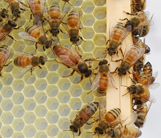
The first law regulating apiculture in the Republic was passed in 1921. This law was passed primarily in response to a major outbreak of a highly contagious and lethal honey bee disease - American Foulbrood (AFB). Initial efforts of the Apiary Inspection Program focused on moving colonies from old fashioned "log" and "box" hives - which could not exist inspected for disease, into modernistic removable frame hives. Apiary inspectors also educated beekeepers on the proper control and prevention of bee diseases.
The current Bee Law, passed in 1994, was a collaborative try between the Pennsylvania State Beekeepers' Clan and the Pennsylvania Section of Agriculture's Agency of Constitute Industry. To increment efficiency of the inspection service, the new police required all apiaries in the land to be registered. The current cost of registration is $10 for approximately two calendar years. The Bee Law continues to regulate the movement of dearest bees, queens, and used equipment into and out of Pennsylvania in society to mitigate bee disease outbreak and spread. In add-on, the Bee Law provides for quarantine action when potentially-threatening pests, pathogens and parasites are discovered. This activity can be used to temporarily protect the beekeeper and beekeeping manufacture from potentially-harmful foreign organisms that are new to the region, allowing for time to assess and incorporate the result before it is a trouble.
The Apiary Department's Apiary Inspection Program is charged with carrying out the Bee Police. When possible, a squad of seasonal apiary inspectors is hired to inspect colonies throughout Pennsylvania during the active bee season (approximately May through mid-Oct). Inspections are prioritized in roughly this gild: apiaries that had previous outbreaks of American Foulbrood (AFB), queen breeding and nucleus(nuc) production yards, interstate move of love bees, new beekeepers, apiaries that accept not had a contempo inspection, and then all other apiaries. When an inspector finds or suspects a case of AFB or other regulated organism, the apiary containing the colony is quarantined equally samples are processed in Harrisburg to confirm infection. Beekeepers are notified of the diagnosis and, if positive, are provided a treatment order outlining advisable treatment options. In the instance of AFB, compliance must be completed within 14 days of receiving the order and apiaries are revisited twice per year for two years following treatment. Other types of inspections include: certification for queen and/or nucleus colony producers, compliance inspections for interstate motion of bees and equipment, and national dearest bee disease survey inspections.
Dearest packing and sale regulations are governed past the Pennsylvania Section of Agriculture'southward Bureau of Food Safety.
American Foulbrood
American Foulbrood (AFB) is caused by a spore-forming bacterium called Paenibacillus larvae. The infection begins when nurse bees feed larvae food contaminated with the spores. The spores germinate into the active vegetative form of the leaner in the larval intestines, rapidly spreading and infecting all larval tissue. The larvae dice, usually later on the jail cell is capped. This creates unfavorable conditions for the vegetative form of the bacteria. The bacteria then form millions of infective spores in the larval remains. The dried remains of AFB infected larvae are called scale and they become "glued" to the prison cell.
For more than information, please read our guide on American Foulbrood (PDF).
Pollination Services
An estimated 80% of our crops (by type not quantity produced) are dependent on insect pollination. Of those, honey bees are the near widely used and dependable of pollinators. All the same, it has been recognized that crop production in Pennsylvania is dependent on the presence of non-honey bee pollinators. The goal of the Apiary plan at the Pennsylvania Section of Agriculture is to support efforts to decide to what extent pollinators play a role in our natural and agricultural ecosystems.
The Pennsylvania Native Bee Survey (PANBS) was started in 2006 by the Apiary Section to identify native pollinators in the Republic. In 2010, the first Pennsylvania Checklist of Bees was published, identifying 371 species known to have existed historically or currently found in the Republic. As the PANBS has continued to expand in scope, a baseline of information is being developed to clarify bee population changes over fourth dimension.
During National and Pennsylvania Pollinator Week in June 2011, a portion of Commonwealth holding was set bated as the futurity site of a pollinator garden, highlighting the importance of natural habitat to back up our pollinators. The planned site is adjacent to the Pennsylvania Department of Agriculture Building in Harrisburg. The garden will be a coordinated effort betwixt local and statewide organizations and agencies, developing pollinator resource and supporting ecosystem plantings, signs and displays regarding the importance of pollinators in the Republic, and ascertainment areas that will let visitors to encounter the ecosystem at work.
As the Apiary Section moves forward, the focus will morph into a Pollinator Services plan. This new focus volition interact with the Commonwealth'south pollinator industries to accost survey needs, regulatory activities and policy concerns, and coordination of pollinator outreach and instruction.

How To Register My Apiary Pennsylvania,
Source: https://www.agriculture.pa.gov/Plants_Land_Water/PlantIndustry/Entomology/Apiary/Pages/default.aspx
Posted by: wassonpriphy.blogspot.com
0 Response to "How To Register My Apiary Pennsylvania"
Post a Comment